Chapter I
Logarithms
How Mr Napier grew tired of multiplying
MDCXIV
“Can you do Addition?” the White Queen asked. “What’s one and one and one and one and one and one and one and one and one and one?”
“I don’t know,” said Alice. “I lost count.”
Lewis Carroll, Through the Looking-Glass, 1871
Question
How do you multiply huge numbers without actually multiplying them?
The logarithm as a calculator
Before the logarithm became an abstract function in the school syllabus, it was above all a tool – a fast way to calculate. Before calculators existed, astronomers, navigators and mathematicians had to multiply and divide many-digit numbers by hand, and that was slow and error-prone. The logarithm gets around the problem with a single trick: it turns multiplication into addition.
Try it yourself. Add up these numbers in a column:
- 8,127,493
- 5,610,284
- 9,345,611
- 2,078,356
- 6,683,920
- 4,459,172
- 3,391,847
The addition takes under two minutes. Now try multiplying the same seven numbers together – even with a calculator at hand it will take much longer, and by hand it would be hours of drudgery.
This difference is exactly why the logarithm was invented. If there were a table in which you could find the “logarithm” of every number, you would only need to add the logarithms and then look up in the table which number the sum corresponds to – the result of the multiplication, without multiplying even once.
Person
A Scottish landowner who worked on one idea for twenty years.
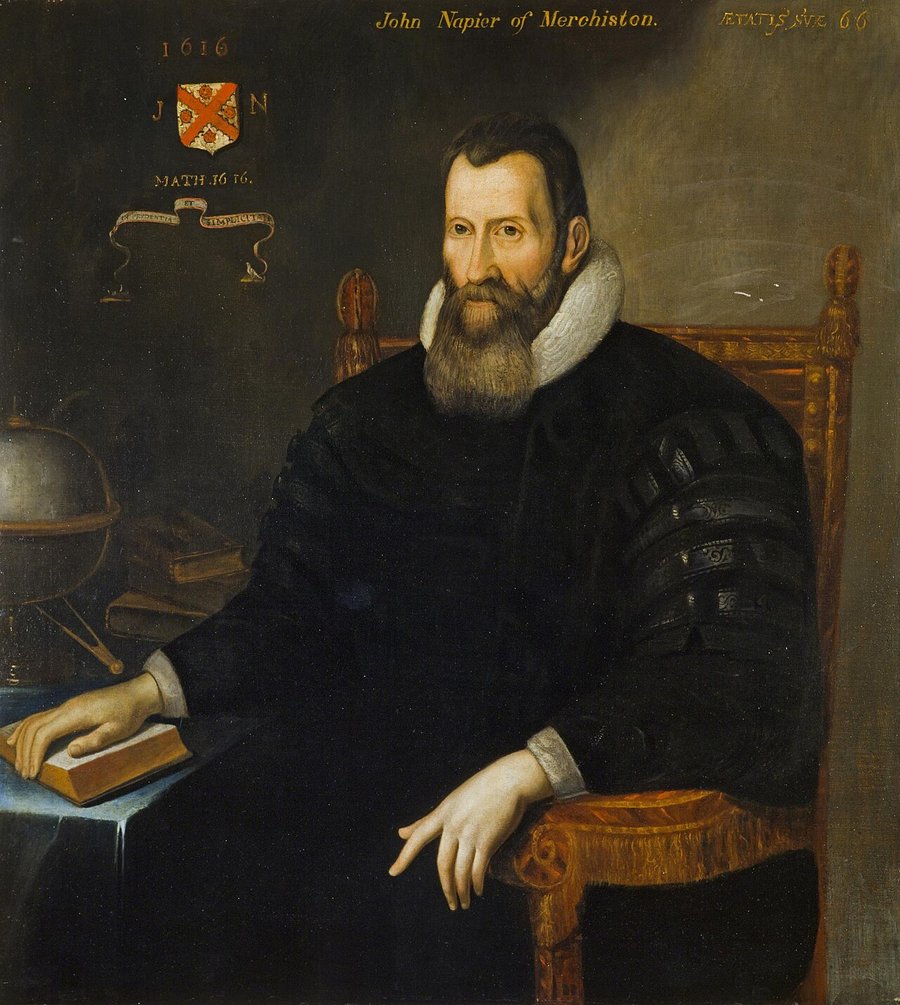
John Napier
John Napier (1550–1617) was a Scottish mathematician, physicist, astronomer and landowner from Merchiston near Edinburgh. Logarithms were a side interest for him – he made his living mainly by running his estate and writing theological works. In mathematics, though, he was immensely persistent: according to the surviving sources he worked on his system of logarithms for about twenty years before describing it in 1614 in the book Mirifici Logarithmorum Canonis Descriptio (A Description of the Wonderful Rule of Logarithms). The book was received with immediate enthusiasm by the mathematicians of the day.
Besides logarithms, Napier is known for inventing Napier’s bones – a mechanical aid for multiplication – and for helping to spread the use of the decimal point in writing numbers.
John Napier
1550–1617, Merchiston near Edinburgh
- 1550Born at Merchiston Castle near Edinburgh.
- 1563At thirteen he goes to study at St Andrews.
- 1594Begins working on logarithms.
- 1614Mirifici Logarithmorum Canonis Descriptio is published.
- 1615Henry Briggs visits him; together they agree on logarithms to base 10.
- 1617Rabdologiae, with Napier’s bones, is published. Napier dies on 4 April.
Idea
Two rows of numbers placed side by side.
Arithmetic and geometric sequences
To “make” the logarithm, Napier needed to connect two worlds: the world of multiplication, where numbers grow by being multiplied by the same number again and again, and the world of addition, where numbers grow by having the same number added again and again.
Geometric sequence – multiply by the same number each time: 1, 2, 4, 8, 16, 32, 64…
Each new term is obtained by multiplying the previous one by the same number, the common ratio q.
1, 3, 9, 27, 81… (q = 3)
64, 32, 16, 8, 4… (q = ½)
Arithmetic sequence – add the same number each time: 0, 1, 2, 3, 4, 5, 6…
Each new term is obtained by adding the same number, the common difference d, to the previous one.
3, 7, 11, 15, 19… (d = 4)
20, 17, 14, 11, 8… (d = −3)
When you write these two rows side by side, line by line, something useful happens:
| geometric | arithmetic |
|---|---|
| 1 | 0 |
| 2 | 1 |
| 4 | 2 |
| 8 | 3 |
| 16 | 4 |
| 32 | 5 |
| 64 | 6 |
| 128 | 7 |
| 256 | 8 |
3 + 5 = 8
8 ↔ 256
Want to multiply 8 × 32? Find 8 and 32 in the left column, read off their “partners” on the right (3 and 5), add them (3 + 5 = 8) and find the number in the left column whose partner on the right is the result, 8: it is 256. And indeed, 8 × 32 = 256.
The same table can also divide – instead of adding the right-hand numbers, you subtract them – and take roots, where you divide the number on the right by the degree of the root.
Division 256 ÷ 8
| 256 | 8 |
| 8 | 3 |
8 − 3 = 5 ⇒ 32
Square root √256
| 256 | 8 |
8 ÷ 2 = 4 ⇒ 16
This table is in fact a prototype of a table of logarithms: the left column holds the “numbers”, the right column their logarithms to base 2.
Where the word “logarithm” came from
At first Napier did not call his new numbers logarithms. In the manuscript we now know as the Constructio, he called them artificial numbers, because they are numbers that the mathematician “makes” himself to lighten the work, not numbers that directly measure anything. Only later, in the Descriptio, did he come up with a new name: logarithm, made of two Greek words – logos (ratio, word, reckoning) and arithmos (number). So a logarithm is literally a “ratio number”: a number that expresses a ratio, that is, how many times the base has to be multiplied.
The problem of choosing a base
Our table of powers of two (1, 2, 4, 8, 16…) is nice as a demonstration, but useless for practical calculation. Almost all numbers are missing from it – there is no row for 3, 5, 6, 7… And the further down the table you go, the bigger the gaps between the numbers (between 128 and 256, 127 whole numbers are missing). For the table to be of any use, you need almost no gaps between neighbouring numbers – which means choosing a base very close to 1.
That is exactly what Napier did. As the ratio between neighbouring terms he chose the number 0.9999999 (seven nines after the decimal point), and as the first number of the sequence 10,000,000. The second term is 10,000,000 × 0.9999999 = 9,999,999 – just one less. Each further step takes away only a tiny bit, so the table covers the numbers densely, with practically no gaps.
How he worked it out without computing 10 million numbers
If Napier had wanted to compute the logarithm of every number from 1 to 10,000,000 this way, he would have had to carry out millions of multiplications by hand – one human lifetime would not have been enough. So he used a cleverer method: instead of computing one giant table, he computed three shorter “ladders” of numbers nested inside each other.
The first ladder had 101 numbers and used the ratio 0.9999999 (the one from the previous section). The second ladder had 51 numbers and a slightly bigger step, derived from the end of the first ladder. The third ladder was a table of 69 rows and 21 columns, with an even bigger step. By combining these three ladders and estimating between them, Napier could determine the logarithm of practically any number without computing all 10 million values one by one.
Even so, it took him about twenty years. He described the result in 1614 in the book Mirifici Logarithmorum Canonis Descriptio (A Description of the Wonderful Rule of Logarithms) – a book that was later said to have “freed the world from the burden of calculation”.
Napier’s exact method is mathematically more involved; this is a simplified but factually correct description of the principle. Source: D. Roegel, Napier’s ideal construction of the logarithms, 2012.
Formula
Only now the notation, a short record of everything that came before it.
What is a logarithm?
Now that we know the whole story, we can answer the question we have been putting off: what does a logarithm actually do?
A logarithm asks: to what power must I raise the base to get a given number?
Notice that the same number appears in both forms – we are just asking about it differently. On the left it is the exponent, on the right the result of the logarithm. Two names for the same thing.
The logarithm as a count of growth steps
Imagine a single cell in a Petri dish. After an hour it divides into two. After another hour each of those two divides again – now you have four. The population doubles every hour.
A question you might ask is: how many hours will it take until the dish contains 32 cells?
You can work it out forwards, step by step: 1 → 2 → 4 → 8 → 16 → 32. Five doubling steps were enough.
And that is exactly what a logarithm is. It does not ask “how big a number will I get”, but “how many growth steps do I need to get there”. log2(32) = 5, because five is the number of doublings that take you from 1 to 32.
- log2asks: how many times must I double to reach this number?
- log10would ask: how many times must I multiply by ten?
So a logarithm is really a counter of growth steps – whether growth means cells dividing, money earning interest, or the number of people a piece of news reaches.
FORMULA
logn y = x ⇔ nx = y
log (a · b) = log a + log b
What took Napier twenty years, we now write in two lines.
The natural logarithm of a number x is the area under the curve 1/t from 1 to x:
Next time we will see how this relation was arrived at.
END OF THE FIRST CHAPTER